How to Define Drone Flight Authorization Rules Before a Jobsite Airspace Conflict Stops Work
Without written flight authorization rules, drone operations on active jobsites create airspace conflicts, liability gaps, and crew coordination failures that ground the program.
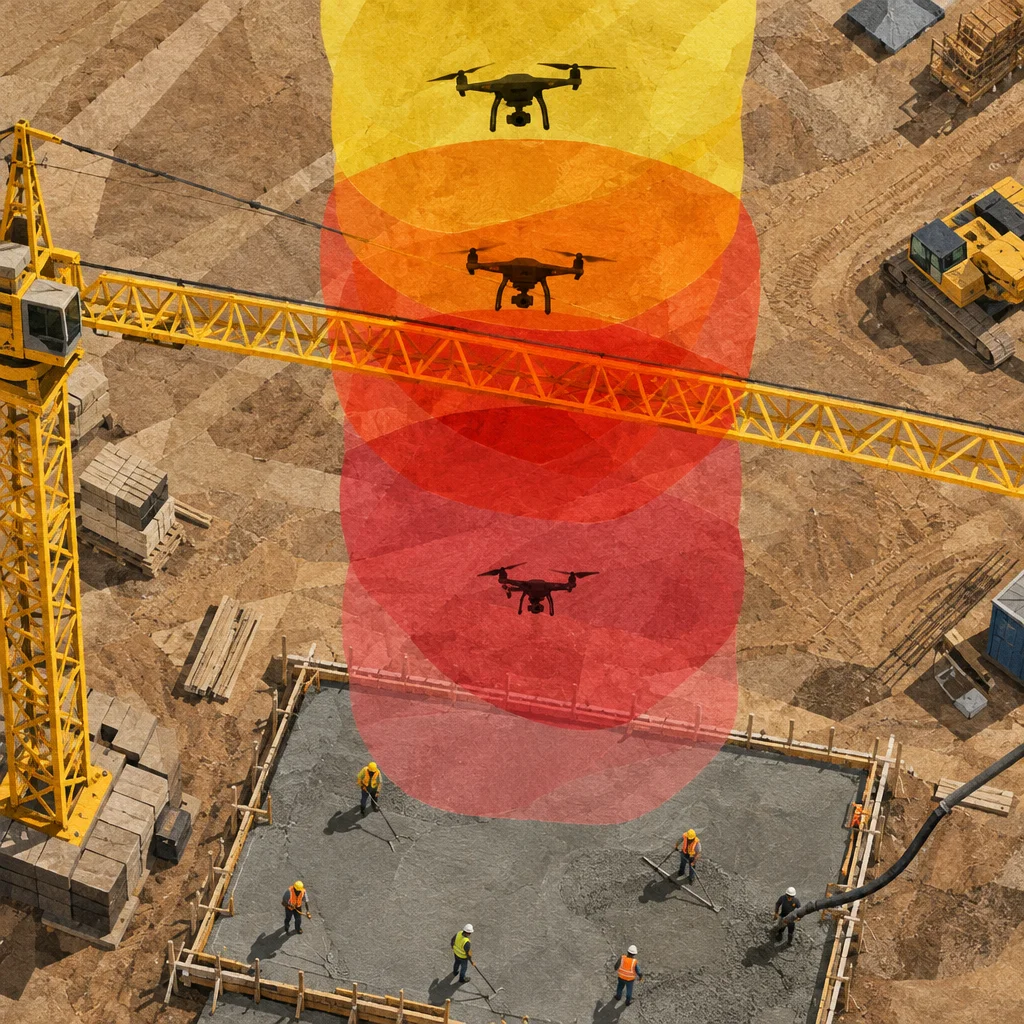
Drone programs on construction jobsites rarely fail because the hardware is wrong. They fail because no one wrote down who can authorize a flight, what conditions make a flight safe, and what happens when two crews need the airspace at the same time. Those gaps stay invisible until a near-miss, a grounded inspection, or a subcontractor complaint makes them expensive to ignore.
This article walks through the authorization decisions a project team needs to make before the first flight, not after the first incident.
Why Authorization Rules Matter Before You Fly
A drone operating over an active jobsite shares space with cranes, personnel hoists, workers on elevated surfaces, and sometimes fixed-wing aircraft near airports. Any one of those interactions can create a safety event. Beyond the physical risk, uncoordinated flights create liability questions that your contract language probably does not answer: Who approved this flight? Was the area clear? Who holds the footage, and who has the right to share it?
Written authorization rules answer those questions in advance. They also give superintendents and subcontractor foremen a concrete process to follow rather than a judgment call they are not equipped to make consistently.
The Core Authorization Decisions to Document
Who can request a flight. Decide which roles may submit a flight request. Limiting requests to project managers, safety officers, and survey leads keeps casual use from creating unplanned airspace activity. If subcontractors want drone coverage for their own scope documentation, they should route through the same request path, not operate independently.
Who can approve a flight. The approving role should have enough situational awareness to confirm that the airspace, the crew, and the site conditions are ready. On most projects, this is the superintendent or a designated drone program lead. The approver should not be the same person as the pilot when avoidable, because independent confirmation catches things a pilot focused on the task will miss.
What information a request must include. A minimal request should document the flight purpose, proposed area, proposed altitude, estimated duration, and the pilot's license status. If the project is within controlled airspace and requires FAA authorization under LAANC or a waiver, confirmation of that authorization should be part of the record before approval, not an afterthought.
What site conditions must be true before flight. Write out the conditions that block flight regardless of who requested it. Common examples include wind above a defined threshold, active crane swing in the flight zone, precipitation, visibility below a defined distance, and any time a personnel hoist is moving loads in the planned corridor. These are not judgment calls during flight prep. They are checkboxes that must be cleared before the drone leaves the ground.
How crews in the affected area are notified. A flight authorization that never reaches the workers below it is not an authorization, it is a paperwork exercise. Define how and when the superintendent notifies trade foremen in the flight zone. Radio, daily huddle, and posted notices at access points are all common options. The method matters less than the requirement that it happens before the flight begins.
Handling Simultaneous or Conflicting Requests
On larger projects or compressed schedules, two crews may request flights at the same time over the same or overlapping areas. Without a written conflict resolution rule, those situations either stall or escalate to whoever happens to be available, which is rarely the right decision-maker.
A simple priority framework helps. As a suggested approach, safety inspections and owner-required progress documentation take precedence over internal scope documentation. Within the same priority tier, first-submitted requests win unless the approver has an operational reason to sequence differently. The approver documents the reason when they override submission order.
If your project uses a field collaboration or project controls platform with a task or permit workflow, flight authorization requests can often be routed through that system rather than email or verbal handoffs. This keeps the approval record in the same place as other permit-to-work activity and makes the log easier to retrieve if something goes wrong.
Regulatory Authorization Is Separate from Site Authorization
FAA authorization under Part 107 and site authorization are two different things, and your rules should treat them as two separate checkboxes rather than one. A pilot who holds a valid remote pilot certificate and has obtained LAANC authorization for a controlled airspace flight still needs your site's approval process before flying. A pilot who has site authorization but has not confirmed FAA authorization for restricted airspace should not fly regardless of project urgency.
Building this distinction into your written process prevents the common situation where a project team assumes that a licensed pilot with a logged flight plan has cleared every hurdle when they have only cleared one of them.
Documentation After the Flight
Post-flight documentation is the other half of an authorization system. At minimum, log the pilot, the area flown, the date and time, the purpose, and any anomalies observed during or after the flight. If the drone records footage or captures point cloud data, document where that file is stored, who owns it, and how long it will be retained.
This record supports several downstream needs. If a safety incident is later alleged to have occurred near a drone flight, the log either confirms or clears the timeline. If the project owner requests documentation of a specific site condition on a specific date, the log tells you which flight file to retrieve. If a subcontractor disputes a survey measurement, the post-flight log establishes the capture parameters.
The log does not need to be elaborate. A structured row in a shared spreadsheet or a short form in your field platform is sufficient, as long as it is filled out consistently and stored somewhere accessible to the project record.
Connecting Authorization Rules to Broader Site Governance
Drone authorization rules work best when they are part of a broader site technology governance document rather than a standalone procedure that lives only with the drone program lead. When rules are embedded in project startup documentation alongside crane pick plans, permit-to-work procedures, and subcontractor mobilization requirements, crews encounter them in context rather than discovering them for the first time during a conflict.
If your organization runs drones across multiple projects, a standard authorization template that project teams customize for site conditions scales more efficiently than building the process from scratch on each project. The customization step matters because airspace conditions, crew sizes, and subcontractor mix vary enough that a one-size rule set will either be too restrictive on simple sites or dangerously vague on complex ones.
The goal is a process that a superintendent can follow without calling the drone vendor, a safety officer can audit without hunting for records, and a project owner can review without finding unexplained gaps. That is a reasonable standard, and it is achievable before the first flight leaves the ground.