How to Define Cost Code Mapping Rules Before a Field Labor Entry and a Budget Line Tell Different Stories
Without written cost code mapping rules, labor hours entered in field apps accumulate against codes that do not match budget line items, producing variance reports no one can trust.
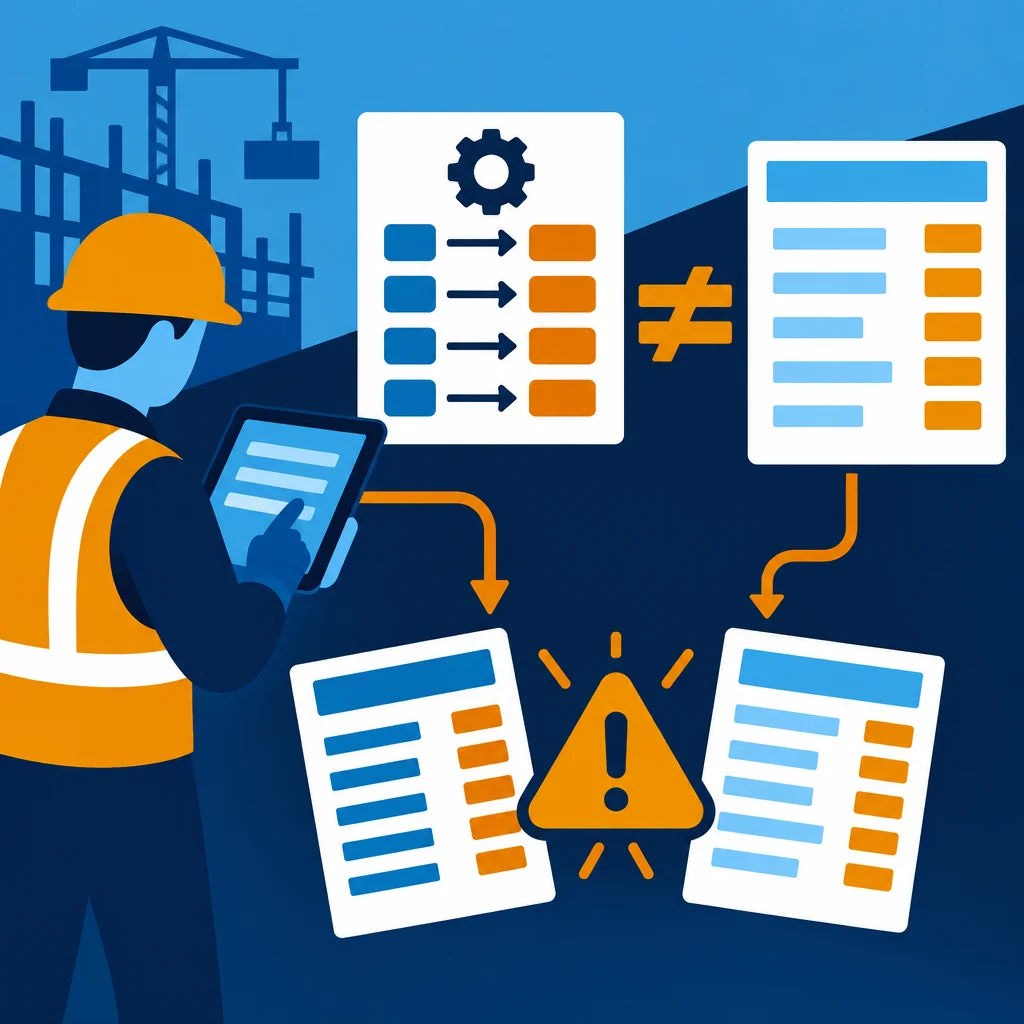
Cost code mapping is one of those decisions that feels like an accounting detail until a project controls manager tries to explain a 15 percent labor variance to an executive and realizes the field crews and the budget have been speaking different languages for three months. The gap is rarely caused by bad data entry. It is caused by the absence of a written rule that connects what a worker types in a field app to the specific budget line item an owner or controller expects to see.
This article walks through what a cost code mapping policy needs to cover, where the common failure points appear, and how to structure the mapping decision in a way that holds across project phases, subcontractors, and software integrations.
Why Field Labor Entries Drift From Budget Lines
Field apps typically ask a worker or foreman to select a cost code when logging hours. The list they see is populated from somewhere: a payroll system, a project management platform, an ERP, or a spreadsheet uploaded at project start. When that source list is not explicitly tied to the chart of accounts in the budget, workers pick the closest-sounding code, or they pick the code they used on the last project, or they pick the first code that appears in a dropdown that was never sorted intentionally.
The result is that hours for a task like structural steel erection might accumulate under three different codes across a crew of ten, depending on what each person or foreman selected. Individually, each entry looks plausible. In aggregate, they produce a cost report that cannot be compared to the budget without manual reclassification, which often happens too late to influence decisions.
What a Mapping Policy Needs to Cover
A useful cost code mapping policy is a written document that answers four questions before work begins on any project.
First, what is the authoritative source of cost codes for this project? The policy should name a single system: the ERP, the project management platform, or the owner's work breakdown structure. Any other system that accepts labor entries must receive its code list from that source, not maintain its own. This prevents the situation where a subcontractor's timesheet app carries codes that were valid on a previous project but do not exist in the current budget.
Second, who is responsible for publishing the code list to field tools before the first timesheet is submitted? This should be a named role, not a named individual, so the responsibility survives personnel changes. A typical assignment is the project controls manager or the project engineer responsible for cost reporting. The policy should include a timing requirement: the list must be available in field tools before mobilization, not after the first week's timesheets reveal the problem.
Third, what happens when a worker cannot find a matching code? Every project encounters tasks that were not anticipated in the original budget structure. The policy should define a holding code or a provisional code that captures the hours without corrupting an existing line item, along with a process for reclassifying those hours within a defined window, such as 48 hours or by end of week. Without this, workers either skip the entry entirely or force hours into the nearest available code, both of which are worse outcomes than a temporary holding code.
Fourth, how are code changes communicated when the budget is revised mid-project? Scope changes, change orders, and budget restructuring all affect the cost code list. The policy should require that any change to the master code list is pushed to field tools within a defined period and that field teams receive notification before the change takes effect. A code that disappears from a dropdown without warning will simply cause workers to select an adjacent code, which restores the original problem.
Mapping Across Subcontractor Systems
Subcontractors often operate their own payroll and time-tracking systems, and they may use their own cost code structures internally. A mapping policy needs to address how subcontractor-reported labor hours translate into the general contractor's or owner's cost structure.
One practical approach is to require subcontractors to submit labor hours using the project's cost codes directly, with training provided during onboarding. This works when the subcontractor has a small team on a single project and when the platform is configured to give subcontractor users access to the relevant code list.
A second approach is to maintain a crosswalk table: a written document that maps each subcontractor's internal codes to the project's budget codes. This is more practical when a subcontractor works across many projects and cannot retrain its crews for each one. The crosswalk becomes part of the subcontract onboarding package and is updated whenever either code structure changes. Someone on the project controls team must own the crosswalk and keep it current.
Either approach requires a written rule. An informal understanding that "the subcontractor will figure it out" is not a mapping policy, and it produces exactly the reconciliation problems that consume project controls staff time at month end.
Integration Between Field and Finance Systems
When a field app integrates with an ERP or payroll system, cost code mapping becomes a configuration question as well as a policy question. The integration typically requires a field value to match an expected value in the receiving system. If the field app allows free-text code entry, or if its dropdown list has drifted from the ERP's chart of accounts, the integration will either reject records silently or map them to a default account.
Before go-live, the team responsible for the integration should run a full comparison of the field app's code list against the ERP's current chart of accounts. Any code that exists in one system but not the other should be resolved before the first transaction flows. This comparison should be repeated whenever either system is updated, and the policy should assign responsibility for running that comparison on a defined schedule.
A Reasonable Starting Point
For teams building a cost code mapping policy from scratch, a suggested starting structure includes: a designated authoritative code source, a named role responsible for distributing the list to field tools, a holding code with a reclassification window, a subcontractor crosswalk requirement, and an integration validation step before each project phase begins. That structure does not need to be long. A one-page written policy that answers those five points will prevent most of the variance report confusion that otherwise surfaces at month-end reviews.
The goal is not perfect cost code discipline on day one. The goal is a written rule that gives field workers, project controls staff, and finance teams a shared reference point when the codes do not line up. Without that reference, every variance discussion starts with a disagreement about whose data is correct, and that disagreement is the most expensive part of the problem.