How to Define Commissioning Data Requirements Before a Building System Goes Through Functional Testing
Without written commissioning data requirements, functional testing produces pass/fail records that no two systems store in compatible formats, leaving owners with gaps they discover during the first warranty claim.
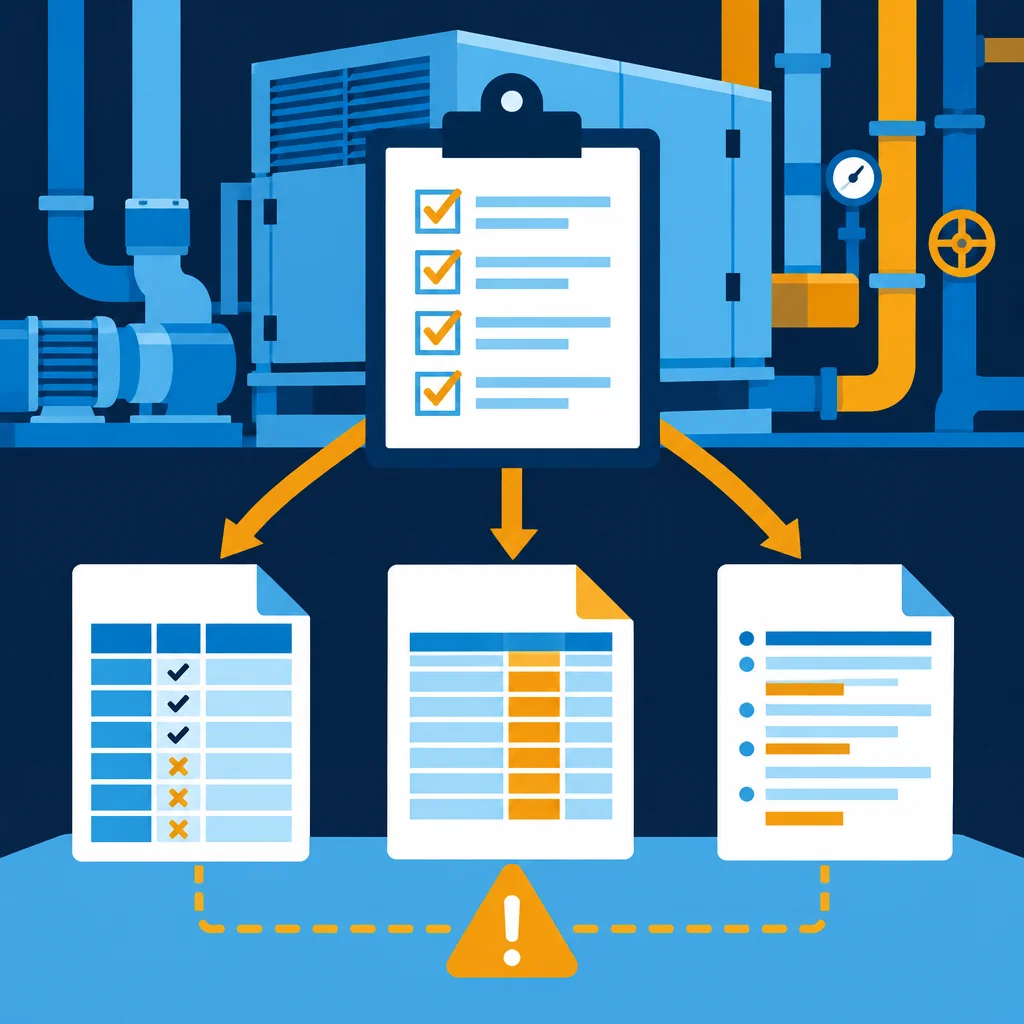
Commissioning sits at the boundary between construction and operations, which makes it one of the most data-intensive handoff points on any building project. Controls contractors, MEP subcontractors, commissioning agents, and owners all generate records during functional testing, but they rarely agree in advance on what those records need to contain, how they should be structured, or which system should hold the authoritative copy. The result is a pile of spreadsheets, PDFs, and commissioning platform exports that describe the same test from incompatible perspectives and cannot be merged without manual reconciliation.
Defining commissioning data requirements before testing begins is not a documentation formality. It is a decision that determines whether your building automation system, CMMS, and project closeout platform can exchange records without a human translator standing between them at the end of the project.
What Commissioning Data Actually Includes
Functional performance testing produces several distinct data types that teams frequently conflate. Test procedure records describe the sequence of steps performed and the conditions under which each step ran. Test result records capture measured values, setpoints, observed behavior, and pass/fail status for each point in the sequence. Deficiency records document failures, corrective actions, and retest outcomes. Equipment identity records link each test to a specific asset by tag number, system designation, and physical location.
Each of these types has different downstream consumers. The CMMS needs equipment identity and baseline performance values to populate preventive maintenance records. The controls contractor needs deficiency records to close out punch items. The commissioning agent needs procedure and result records to produce the final commissioning report. The owner's facilities team needs all four types, organized by asset, to support warranty claims and future troubleshooting.
When teams do not specify which data type each system should own, they end up with partial copies everywhere and authoritative copies nowhere.
Where the Gaps Appear in Practice
Consider a hypothetical mid-size commercial project where the mechanical contractor uses a commissioning software platform, the controls contractor logs test results in a proprietary startup tool, and the commissioning agent maintains a master checklist in a shared spreadsheet. Each tool captures test outcomes, but they use different equipment tag formats, different pass/fail terminology, and different timestamp conventions. At closeout, reconciling these three sources requires someone to manually match records across all three systems for every tested point.
This scenario is common enough that commissioning agents frequently describe it as expected friction rather than a solvable problem. It does not have to be that way. The fix is not a new platform. It is a written requirement document produced before testing begins that specifies the exact fields each record must carry, the tag format every party must use, and the system designated as the record of authority for each data type.
Writing the Requirement Document
A useful commissioning data requirement document covers four topics.
Equipment tag format. Every record generated during testing must reference the asset using a single agreed tag format. If the project uses a hyphenated format like AHU-3-02, every tool must use exactly that format. Variations like AHU 3-02 or AHU3.02 will prevent automated matching at closeout and in the CMMS. Specify the format in writing and require every participating party to confirm their tool can output it.
Required fields per record type. List the fields that must be present in every test result record. At minimum, these typically include equipment tag, system designation, test date and time, technician identifier, procedure reference, measured value, design value, tolerance, and pass/fail status. If the commissioning agent's report requires outdoor air temperature at time of test, that field belongs in the written requirement, not as a verbal expectation.
File format and delivery method. Specify whether records must be delivered as structured data files, PDFs with named fields, or direct API transfer to the owner's platform. A PDF that a human must read is not the same as a structured file that a CMMS can ingest. If the owner's facilities platform requires CSV or a specific XML schema, that requirement must appear in writing before any contractor selects their commissioning tool.
Deficiency record lifecycle. Define what a deficiency record must contain when it is opened, what fields must be updated when corrective action occurs, and what constitutes a closed record. Without this, deficiency status exists only in the commissioning agent's tracker and never reaches the project controls system that tracks punch item completion.
Connecting Commissioning Records to Downstream Systems
The owner's CMMS is the most common downstream consumer of commissioning data, but it is not the only one. Building automation systems often need verified setpoints confirmed during commissioning. Warranty management platforms need test dates and equipment serial numbers. Energy management systems may need baseline performance values that commissioning establishes.
Each of these connections requires a field-level mapping. If your CMMS asset record expects a field called SystemType and your commissioning platform exports a field called MechanicalCategory, one of those labels needs to change before the project ends, or a human must translate every record by hand. Identifying these mismatches during the requirement-writing phase, not at closeout, is the practical purpose of the exercise.
It is worth asking your CMMS vendor, your commissioning agent, and your controls contractor to each produce a sample export record in their native format before testing begins. Comparing three sample records side by side surfaces the field mismatches that a written requirement document can then resolve by mandate.
Assigning Ownership Before Testing Starts
Every commissioning data type needs a single designated owner responsible for maintaining the authoritative copy. Assigning ownership does not mean other parties cannot hold working copies. It means one party is contractually responsible for the record's completeness, accuracy, and delivery format at closeout.
A reasonable starting point is to assign procedure and result records to the commissioning agent, deficiency records to the general contractor's project controls team, and equipment identity records to whoever is responsible for populating the CMMS. This is a suggestion, not a rule. The right assignment depends on contract structure and which parties have the tools and access to maintain each type reliably. What matters is that the assignment is written, reviewed by all parties, and included in the commissioning plan before the first functional test runs.
The Practical Outcome
Teams that define commissioning data requirements before testing begins typically find that closeout is faster, warranty claims are easier to support, and the owner's facilities team starts operations with records they can actually use. The work required to produce the requirement document is modest compared to the manual reconciliation it prevents. The decision point is before the commissioning agent is engaged and before tool selections are finalized, which is the moment when requirements can still shape behavior rather than document regret.